Dental Implants in Lynwood
Last updated: November 9, 2026
A dental implant is the closest thing to getting your own tooth back: a small titanium post placed in the jaw where the root used to be, with a crown on top that looks, feels, and works like a natural tooth. At PhD Dental in Lynwood, implants are placed by our periodontist, Dr. Ori Levy, who sees patients at our office at 3737 Martin Luther King Jr Blvd, Suite 375, on scheduled days — so implant care stays within the same practice that handles your cleanings, fillings, and checkups. If you are missing a tooth, or tired of a denture that moves, call (310) 861-7742 and book a consultation. Without insurance, it starts with an exam and a full set of x-rays for $69.
What is a dental implant?
An implant has three parts: the implant itself — a titanium post that is placed in the jawbone and fuses with the bone over time; a connector; and the crown you see and chew with. Because the post acts like a tooth root, an implant does something a bridge or denture cannot: it keeps stimulating the bone in that spot, which is what stops the bone from shrinking away after a tooth is lost. Implants can replace a single tooth, several teeth, or anchor a full denture so it stops slipping.
Meet Dr. Ori Levy, the periodontist who places your implant
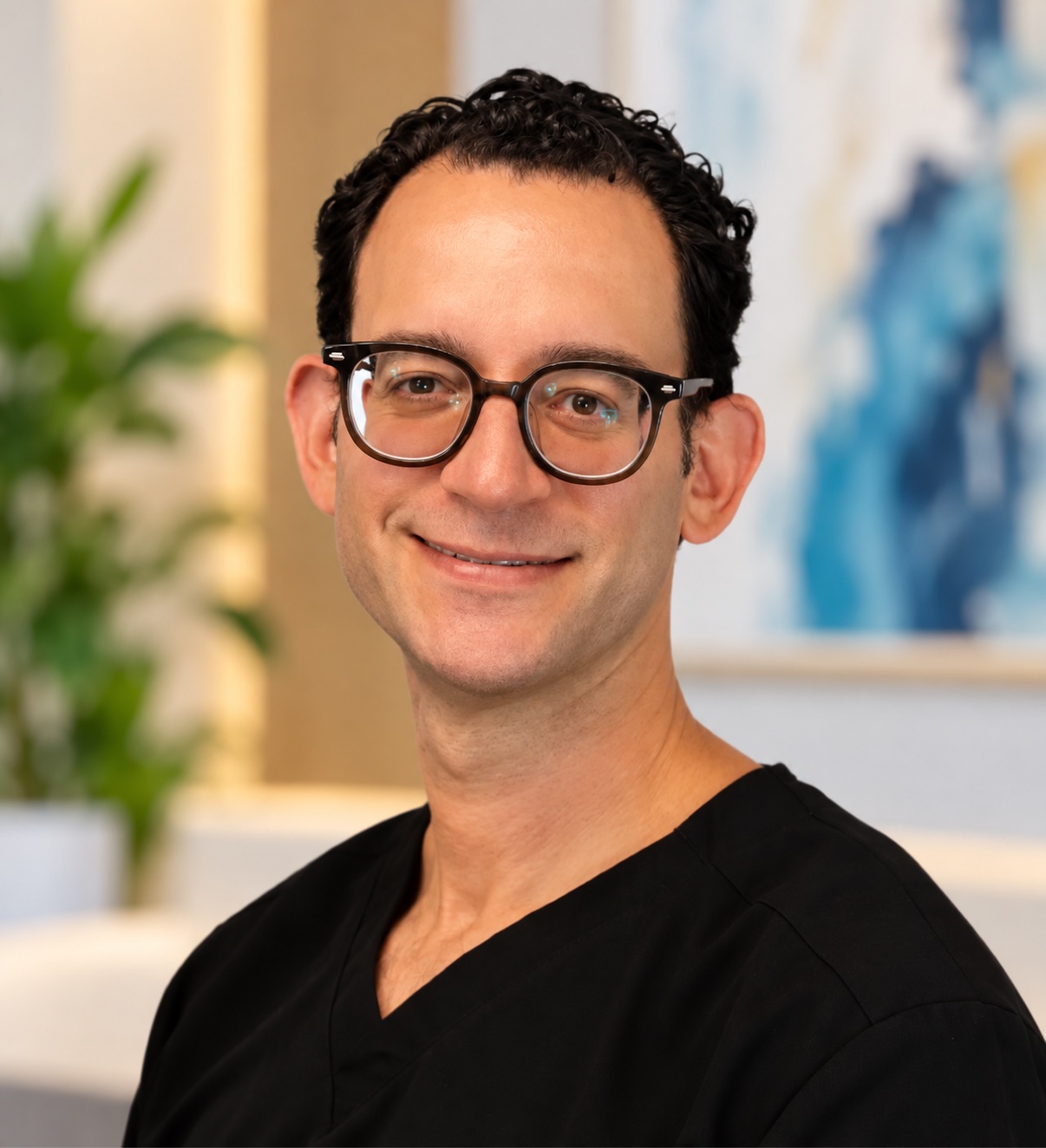
Dr. Ori Levy is the periodontist who places dental implants at PhD Dental. He sees patients across our offices on scheduled days, including here in Lynwood. At your consultation he reviews your bone health, your medical history, and your x-rays, and tells you plainly whether an implant is the right fix for the tooth you are missing — and if a bridge, a partial denture, or no treatment yet is the smarter answer, you will hear that instead. Specialty care stays within the practice: your Lynwood team and Dr. Levy work from the same records and the same plan.
Who is a good candidate for a dental implant?
Most adults missing one or more teeth are candidates. The two things that matter most are enough healthy bone to hold the post — and if the bone has thinned since the tooth was lost, preparation or grafting can sometimes rebuild it — and gums free of active disease, which is why we treat gum problems before placing implants. Health conditions and habits like smoking affect healing and will be part of an honest conversation at your consultation, not a surprise later. Age by itself is not a barrier; many of our implant patients are in their sixties and seventies.
How much do dental implants cost?
An implant has no single set price. The cost depends on how many teeth are being replaced, whether the bone needs preparation first, and the crown that goes on top. What we can promise is the order of events: at your consultation, Dr. Levy examines your mouth, explains the treatment he recommends and the timeline, and you receive a clear cost breakdown in writing before any work begins. We offer in-house payment plans and financing options, so the cost can be spread over time. Your first step — the exam and full x-rays — is $69 without insurance.
How does the implant process work, and how long does it take?
The full process usually takes several months from start to final crown, because the implant needs time to fuse with the bone before the crown is placed on it. In outline: the consultation and planning come first; then the implant is placed; then a healing period while the bone integrates; then the crown is made and fitted. Some patients need a healing period or bone preparation before placement, which adds time. It is a marathon with long rests, not a long series of appointments — most of the timeline is your body doing quiet work between short visits. At your consultation you will get the timeline for your specific case.
Dental implant, bridge, or denture — which is right for me?
Each has a real case for it. An implant stands on its own: it does not touch the neighboring teeth, preserves bone, and with proper care can last many years — often a lifetime — but it costs the most and takes the longest. A bridge is fixed in place and faster, but it requires shaping the healthy teeth on either side of the gap to hold it. A partial denture costs the least and can replace several teeth at once, but it comes out at night and does not protect the bone. There is no universal winner — there is the right answer for your mouth, your health, and your budget, and we will lay the three side by side with prices before you decide.
What are fixed full-arch implant dentures (often called All-on-4)?
If you are missing most or all of the teeth on one jaw — or struggling with a full denture that will not stay put — a fixed full arch attaches a complete set of teeth to a small number of implants, and only the dentist removes them. It is the most life-like way to replace a full arch, and it is planned as a dedicated treatment. Our All-on-X Dental Implants in Lynwood page explains how full-arch planning works at this office, and the team can walk you through whether a fixed arch, a snap-on denture, or a well-made conventional denture fits you best.
How much do fixed full-arch implant dentures cost?
More than any other tooth-replacement option, because it combines implant surgery and a full custom prosthesis — and the exact figure depends on your bone, the number of implants your case needs, and the materials chosen. Nobody honest will quote it over the phone. At your consultation you will get the complete number in writing, along with the snap-on and conventional alternatives priced the same way, and information on in-house payment plans and financing options.
Does insurance help pay for dental implants?
Sometimes in part. Some PPO plans contribute toward implants; many do not, and we will verify your benefits before your visit so you know exactly where you stand — we are in network with Delta Dental. Medi-Cal patients should know plainly: dental implants are generally not a covered Medi-Cal benefit — the program covers them only in rare, severe medical cases, such as after cancer surgery or a major injury to the jaw. What Medi-Cal does cover to replace missing teeth is full and partial dentures, and we make both at this office.
Implant care for Lynwood and the communities around us
Patients come to our Lynwood office for implant consultations from South Gate, Bell, Bell Gardens, Paramount, Downey, Compton, and Watts/Willowbrook — often after years of working around a missing tooth or a loose denture. Because Dr. Levy’s Lynwood days are scheduled, the practical move is to book the consultation now rather than when the gap starts causing trouble; your plan and timeline will already be in place.
Common questions about dental implants
How long do dental implants last?
With proper care, many years — often a lifetime. Daily brushing and flossing, regular checkups, and avoiding damage all help. The crown on top may eventually need replacement from wear, like any restoration.
Can I get dental implants if I have bone loss?
Often, yes. Bone preparation or grafting can rebuild areas that have thinned, and Dr. Levy will assess your bone at the consultation and tell you what your case requires — including if implants are not advisable.
What is the difference between implants and bridges?
An implant replaces the root and the tooth and stands alone; a bridge suspends a replacement tooth between crowns placed on the neighboring teeth, which must be shaped to hold it. Implants preserve bone and leave neighbors untouched; bridges are faster and cost less up front.
Is an implant the same as a “screw-in tooth”?
Essentially, yes — that is how many patients describe it. The implant post is placed in the bone like a root, and the crown is attached to it. It stays in your mouth; you brush it like your own tooth.
What if I am nervous about implant surgery?
Tell us when you book. We explain every step before we start, there are options that help you relax — including nitrous oxide at select offices on request, and a calming medication you can take before your visit if you have a driver — and we will be plain that we do not offer IV sedation.
What if my tooth needs to be pulled first?
That is common. The extraction and the implant plan are made together, and sometimes the implant can be planned around the extraction healing. Dr. Haidar, our oral surgeon, also sees Lynwood patients on scheduled days if the removal is a surgical one.
Can implants help hold my denture?
Yes — a snap-on denture clipped to a few implants is one of the most satisfying upgrades for patients whose lower denture slips. See the Dentures in Lynwood page, or ask at your consultation.
How do I start?
Book a consultation. Exam, full x-rays, an honest recommendation, and the full cost in writing — then you decide.
Book an implant consultation in Lynwood
Call (310) 861-7742 or book online, and ask for Dr. Levy’s next scheduled day at the Lynwood office. We are open Monday to Friday 9:30 AM to 5:30 PM and Saturday 9:00 AM to 4:00 PM. We accept PPO plans and Medi-Cal/Denti-Cal — we do not accept HMO plans — and we will verify your benefits before your visit.
- PhD Dental Lynwood Adults: 3737 Martin Luther King Jr Blvd, Suite 375, Lynwood, CA 90262
- Call: (310) 861-7742
- Book online: Book an appointment
- Hours: Monday–Friday 9:30 AM–5:30 PM, Saturday 9:00 AM–4:00 PM, Sunday closed. We are open on Saturdays.