Dental Implants in Westchester
Last updated: November 10, 2026
A dental implant replaces a missing tooth with a fixed tooth that looks, feels, and works like your own — and in Westchester, the person placing it matters as much as the implant itself. At PhD Dental, implants are placed by our board-certified periodontist, Dr. Ori Levy, who sees patients at our Westchester office, at 6907 La Tijera Blvd, Suite A, Los Angeles, CA 90045, on scheduled days. At your consultation, Dr. Levy reviews your bone health and medical history, explains the treatment he recommends, and gives you a clear cost breakdown in writing before any work begins — so you know whether an implant is right for you, how long it would take, and exactly what it would cost, before you commit to anything. Call (310) 893-6304.
Implants at PhD Dental are not an occasional side service. They are placed by a specialist — a periodontist, not a general dentist who fits in an implant now and then — and the complete journey is handled within one practice: the evaluation and imaging, the placement, the healing, and the two-visit crown restoration. Behind this neighborhood office on La Tijera Boulevard stands PhD Dental’s eight-location group across Greater Los Angeles — specialist care and the complete journey in one practice, with the scale of a group behind it.
What is a dental implant?
A dental implant is a small post placed in the jaw where a tooth is missing. Once it heals and fuses with the bone, it carries a custom-made crown — the visible tooth on top. Unlike a denture, an implant does not come out at night. Unlike a bridge, it does not lean on the teeth beside it. One implant replaces one tooth; implants working together can also replace several teeth, or anchor a denture so it stops shifting.
Meet Dr. Ori Levy, the periodontist who places your implant
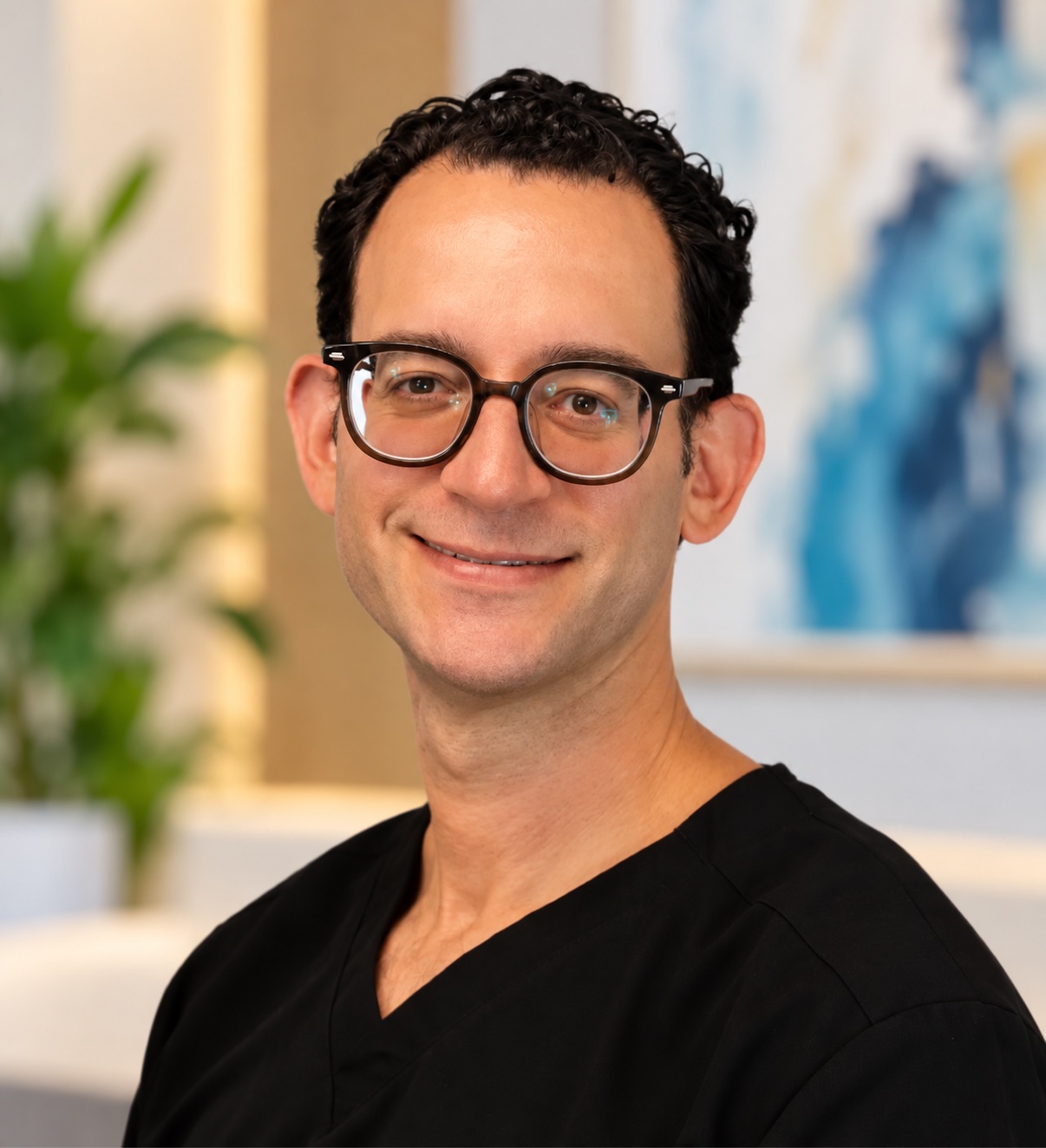
An implant at our Westchester office comes with a named specialist, not a rotation. The periodontist who places it is Dr. Ori Levy — board-certified, a Diplomate of the American Board of Periodontology, and one of the five specialists profiled on our Meet Our Team page. His dental degree is from the UCLA School of Dentistry; his periodontics training was completed at the Greater Los Angeles VA Healthcare System. He brings nearly twenty years of practice to the chair, roughly fifteen of them here at PhD Dental, and he works in English and Spanish.
Dr. Levy’s implant days at Westchester run on a scheduled rotation, and he remains your doctor across the whole arc of treatment: the evaluation of your bone and medical history, the placement itself, the healing checks, and the finished crown at the end. His specialty reaches beyond implants into the groundwork they depend on — gum grafting and bone regeneration that rebuild a site before a post can stand in it. And the plan comes before the commitment: the treatment he recommends, explained, with the cost broken down in writing, before any work begins.
Who is a good candidate for a dental implant?
Most adults who are missing a tooth are candidates, and the consultation is how we confirm it. What matters most is the foundation: healthy gums, and enough jawbone to hold the post while it fuses. At your consultation, Dr. Levy reviews the health of your gums and jawbone, your medical history, and which tooth needs to be replaced.
Sometimes the site needs building up first. Bone under a long-missing tooth gradually resorbs; where too little remains to anchor an implant, grafting can restore the volume and turn a no into a yes. It lengthens the road by some healing months, but it is a detour, not a dead end — the consultation is where your bone gets measured and the question answered.
Plenty of implant journeys begin with a tooth that still has to come out. That conversation happens at the same visit: our oral surgeon holds scheduled days at Westchester for extractions and surgical care, and we walk through every replacement route — its sequence, its timing, its cost — before you decide, including telling you plainly when a different option serves you better.
How much do dental implants cost?
No flat price exists for an implant, and any office quoting one sight-unseen is guessing with your money. The figure is built from your case — here is what goes into it:
- Which tooth, and how many. Replacing one tooth costs less than replacing several.
- Whether the tooth still needs to be removed before the implant can be placed.
- Whether bone preparation or grafting is needed to hold the implant securely.
- The crown that goes on top. The implant post and the finished crown are separate parts of treatment, and both are included in your estimate.
It starts the way everything here starts: the $69 exam, full x-rays included, the two sold as a single package. After the exam your estimate arrives in writing, before treatment; in-house payment plans and financing options can then spread the figure over time.
How does the implant process work, and how long does it take?
Expect the whole arc to run several months, because biology sets the pace: the post must fuse with your bone before it can carry a crown. The stages:
- 1. Consultation. Exam, full x-rays, and a review of your bone health and medical history. You get a timeline for your specific case and a written estimate — before you commit to anything.
- 2. Placement. The implant post is placed in the jaw where the tooth is missing.
- 3. Healing. Over the next several months the implant fuses with the bone. This step is called osseointegration, and it is what makes an implant fixed and stable. Some patients need a healing period or bone preparation before this step, which adds time.
- 4. The crown. Once the implant has fused, the crown — the visible tooth — is made for you and fitted on top. The crown is a separate restoration and takes two visits: one for the records and impression the lab works from, and one to fit the finished crown.
Once the crown is on, upkeep is unglamorous and effective: brush and floss daily, stay on your checkup schedule, and keep professional cleanings current. Looked after that way, implants last many years — frequently a lifetime.
Dental implant, bridge, or denture — which is right for me?
For one missing tooth there are three established replacements, and which is ‘right’ is a question about your mouth, your calendar, and your budget:
- Dental implant. Fixed in place and independent — it does not rely on the teeth next to it, and it helps preserve the jawbone where the tooth was lost. It takes the longest, because of the healing time, and costs the most at the start.
- Bridge. A fixed replacement held by crowns on the teeth on either side of the gap. Finished faster, because there is no healing period — but the neighboring teeth have to be prepared to hold it.
- Denture or partial denture. Removable, and can replace several teeth at once. It comes out at night and can feel less stable than a fixed tooth. Implants can also help hold a denture in place.
Whichever of them fits your case, you will hear it laid out at the consultation — timeline and cost included — before the decision is yours to make.
What are fixed full-arch implant dentures (often called All-on-4)?
When most or all of the teeth in an upper or lower jaw are gone — or going — a fixed full-arch denture rebuilds the entire set in one treatment. A small number of implants anchors the arch; the denture is screwed onto them and stays put, which is why patients call the result ‘permanent teeth’ or ‘teeth that don’t come out,’ and why the treatment carries names like All-on-4 and All-on-X, after the implants doing the holding. It is not taken out at night — only the dentist removes it, and only for maintenance. Set that against the implant overdenture, which snaps on and off so you can clean it: removable by design. The fixed arch is the opposite by design.
Fixed full-arch treatment is offered at every PhD Dental office, Westchester included. The Westchester placements are Dr. Ori Levy’s work — board-certified periodontist, Diplomate of the American Board of Periodontology, DDS from UCLA, specialty training at the Greater Los Angeles VA, nearly two decades of experience and about fifteen years with this practice — seeing patients here on scheduled days. The design runs backward from the finished teeth: implant positions are planned around the smile they must carry, our general dentists build and fit that fixed set, and the laboratory fabricating it works with high-quality implant components. Fusion time is built into the plan, so the full course runs to months; your consultation maps the timeline for your jaw.
How much do fixed full-arch implant dentures cost?
A fixed arch costs more than a removable denture, and the reasons are visible in what it contains: the implants themselves, a specialist placing them, and a complete set of fixed teeth fabricated for one mouth — an entire jaw rebuilt at once instead of a tooth at a time. Your figure turns on one arch or both, on extractions still to be done, and on whether the bone needs preparation to hold the implants. The entry point is the $69 exam with full x-rays, package-priced; after it, the estimate is written, before treatment, and in-house payment plans and financing options can spread what remains.
Does insurance help pay for dental implants?
Implant coverage is one of the most plan-dependent corners of dentistry, which is why our rule is to verify before treatment rather than argue after. Call the Westchester office and we will check what your plan actually covers before you have to decide anything.
PhD Dental is in network with Delta Dental at all eight offices. We also accept Aetna PPO, MetLife PPO, Delta Dental PPO, Cigna PPO, Guardian PPO, UnitedHealthcare PPO, Anthem Blue Cross PPO, Blue Shield of California PPO, Humana PPO, Principal PPO, Ameritas PPO, United Concordia PPO, Sun Life PPO, Lincoln Financial PPO, Unum PPO, The Hartford PPO, Renaissance Dental PPO, Premier Access PPO, and Health Net PPO. Please note we do not accept any HMO plans at this time.
A note on what those words do and do not promise. PhD Dental as a practice takes Medi-Cal, and takes Denti-Cal. That is a statement about the practice, not a promise that either program pays for implant treatment — it generally does not. Implants are planned case by case here, and your written estimate always comes before treatment begins.
Implant care for Westchester and the communities around us
Our Westchester office is on La Tijera Boulevard, and patients come to us for implant consultations from all over this part of Greater Los Angeles. Our closest neighbors — Ladera Heights, Lennox, Del Aire, Playa Vista, and Playa del Rey — are just minutes away, and we also see patients from Culver City, Mar Vista, Palms, Venice, and Marina del Rey. From the beach cities, patients travel in from El Segundo, Manhattan Beach, Hermosa Beach, and Redondo Beach, and we also welcome patients from Hawthorne and Santa Monica. Because Dr. Levy sees implant patients on scheduled days, we plan each stage with you in advance.
Common questions about dental implants
How long do dental implants last?
With proper care, dental implants can last many years, and often a lifetime. Daily brushing and flossing, regular checkups, and avoiding damage all help. At your consultation we review your bone health, medical history, and the maintenance plan that helps an implant last.
Can I get dental implants if I have bone loss?
Very often, yes. Bone shrinks in the years after a tooth is lost, but grafting exists precisely for that problem: it rebuilds the site until an implant can stand in it. The trade is time — grafting adds healing months — not eligibility. At your consultation Dr. Levy assesses your bone directly and gives you a candid answer about what can work.
What is the difference between implants and bridges?
The structural difference is independence. An implant anchors itself in the jaw and, in doing so, helps the bone beneath it stay; a bridge hangs from crowns on the two neighboring teeth, which must be cut down to carry it. A bridge also finishes sooner — no fusion period — while an implant trades speed for that independence. The section above compares them fully, and your consultation applies the comparison to your actual gap.
Is an implant the same as a ‘screw-in tooth’?
Patients say it, and it is close enough to true: the implant is the post set into the jaw; the crown mounted on it is the visible tooth. Fitted together, the two give you a fixed replacement that stays in your mouth day and night.
What if I am nervous about implant surgery?
Flag it when you schedule, and it becomes part of the plan. Nitrous oxide can be requested at select offices; a prescription calming medication for the night before and the morning of is the other route, and it comes with a driver — you cannot drive yourself on it. Between those two, most anxious patients find implant day very manageable.
What if my tooth needs to be pulled first?
If a tooth cannot be saved, we can remove it and talk through replacement at the same visit. Our oral surgeon sees patients at our Westchester office on scheduled days for extractions and surgical care, and options include implants, bridges, and partial dentures. We will explain each option, the timeline, and the cost before you decide. If that tooth is painful or broken, call our Westchester office — we provide urgent dental care, and walk-ins are welcome.
Can implants help hold my denture?
Yes. Implants can replace a single tooth, or help hold dentures in place so they do not shift while you eat and talk. Your consultation will show which arrangement fits your case.
How do I start?
The first step is the $69 exam with its full set of x-rays. Out of it comes a plan for your case, the sequence it will follow, and a written estimate — everything on the table before you commit. Walk-ins are welcome at the Westchester office.
Book an implant consultation in Westchester
Call our Westchester office at (310) 893-6304 to book an implant consultation with Dr. Levy, or book online anytime. He sees patients at our Westchester office on scheduled days, and if he is not in Westchester on the day you need, we will book you at the nearest office and coordinate your care. Walk-ins are welcome.
- PhD Dental Westchester: 6907 La Tijera Blvd, Suite A, Los Angeles, CA 90045
- Call: (310) 893-6304
- Book online: Book an appointment
- Hours: Monday–Friday 9:30 AM–6:30 PM, Saturday and Sunday closed. (On Saturdays, our Inglewood office is open 9:00 AM–4:00 PM.)