Dentures in Westchester
Last updated: November 21, 2026
Missing most or all of your teeth changes ordinary life in unordinary ways: menus get edited by your mouth instead of your appetite, words with S sounds take practice, smiling becomes a decision. Dentures exist to hand those things back. At PhD Dental in Westchester, at 6907 La Tijera Blvd, Suite A, Los Angeles, CA 90045, we make conventional full dentures, partial dentures, immediate dentures, implant overdentures that snap onto implants and stay put, and fixed full-arch implant dentures that are secured to implants and do not come out at all. Which kind fits you depends on how many teeth you have left, the health of your gums and jawbone, and your budget — and the way to find out is to start with an exam and a full set of x-rays for $69, after which you receive a written cost breakdown before any work begins. Call (310) 645-0336.
What are dentures?
Dentures are removable replacement teeth — the ‘false teeth’ of everyday speech — made to stand in for missing teeth and the gum tissue around them. A full denture replaces every tooth in the upper jaw, the lower jaw, or both. A partial denture replaces some teeth and clips onto the healthy teeth that remain. A temporary partial denture, sometimes called a flipper, replaces one or a few teeth for a limited stretch — while you heal, or while a longer-term plan is being made. Nothing about a denture is off-the-shelf: yours is made for you, from records of your mouth, by a high-quality dental laboratory our offices work with, so shape, fit, and appearance are matched to your face and your bite.
I still have some healthy teeth — can I get a partial denture?
Yes, and that is often the smartest version of the plan. If some of your teeth are healthy and strong, a partial denture replaces only the missing ones and holds onto the teeth you keep — and keeping your own teeth where they are healthy is usually the better course, because natural teeth help hold the partial steady and help preserve the jawbone beneath them. If some of your remaining teeth are damaged, the exam draws the honest line: which teeth are strong enough to support a partial, which need treatment first, and which cannot be kept. A partial built on failing teeth fails with them, so we will tell you plainly where that line falls in your case before anything is made. You do not have to fix everything in your mouth first — but the teeth the partial holds onto have to be sound enough to hold it. Our Partial Dentures in Westchester page covers this option in full.
My teeth have to come out — do I have to go without teeth?
No. That gap is exactly what an immediate denture is designed to prevent: it is made in advance, from records taken before your extraction appointment, and placed the same day the teeth come out, so you leave wearing teeth while your gums heal underneath. Healing changes the shape of your gums over the following months, and the denture is adjusted through that settling period to keep it fitting — a normal, planned part of the process. A conventional denture takes the opposite route: it is made after the gums have healed from extractions, fitted to the healed shape of your mouth from the start. Which route fits you — including the point that broken roots left in the gum have to be removed before a denture can fit over them properly — is worked out at your consultation, before any teeth come out.
How are dentures made, and what does the process look like?
The making of a denture follows a predictable path:
- 1. Consultation. Exam, full x-rays, and a review of your remaining teeth, gums, and jawbone. You get a written cost breakdown before any work begins.
- 2. Records. Impressions and measurements of your mouth, plus the shade and shape of the teeth, chosen with you — yes, you choose the shade of your denture teeth, with the dentist’s guidance on what looks natural against your skin tone and remaining teeth.
- 3. Fabrication. The laboratory makes your denture from those records. For an overdenture, the implants are placed first and given time to fuse with the bone before the denture is finished to snap onto them — that part of the journey takes longer, and your consultation will lay out the full timeline for your case.
- 4. Fitting and adjustments. Your denture is fitted, your bite is checked, and small adjustments are made as your mouth settles.
My denture slips when I eat — what is a snap-on denture?
A snap-on denture — an implant overdenture — is a removable denture that clips onto dental implants placed in the jaw, typically two implants on the lower jaw and usually four on the upper jaw. Instead of resting only on your gums, it snaps onto the implants and stays seated while you eat and talk, then comes out at night for cleaning like a regular denture. The loose lower denture is the most common reason patients ask about it: the lower denture has the least anatomy to hold onto, and two implants transform that equation.
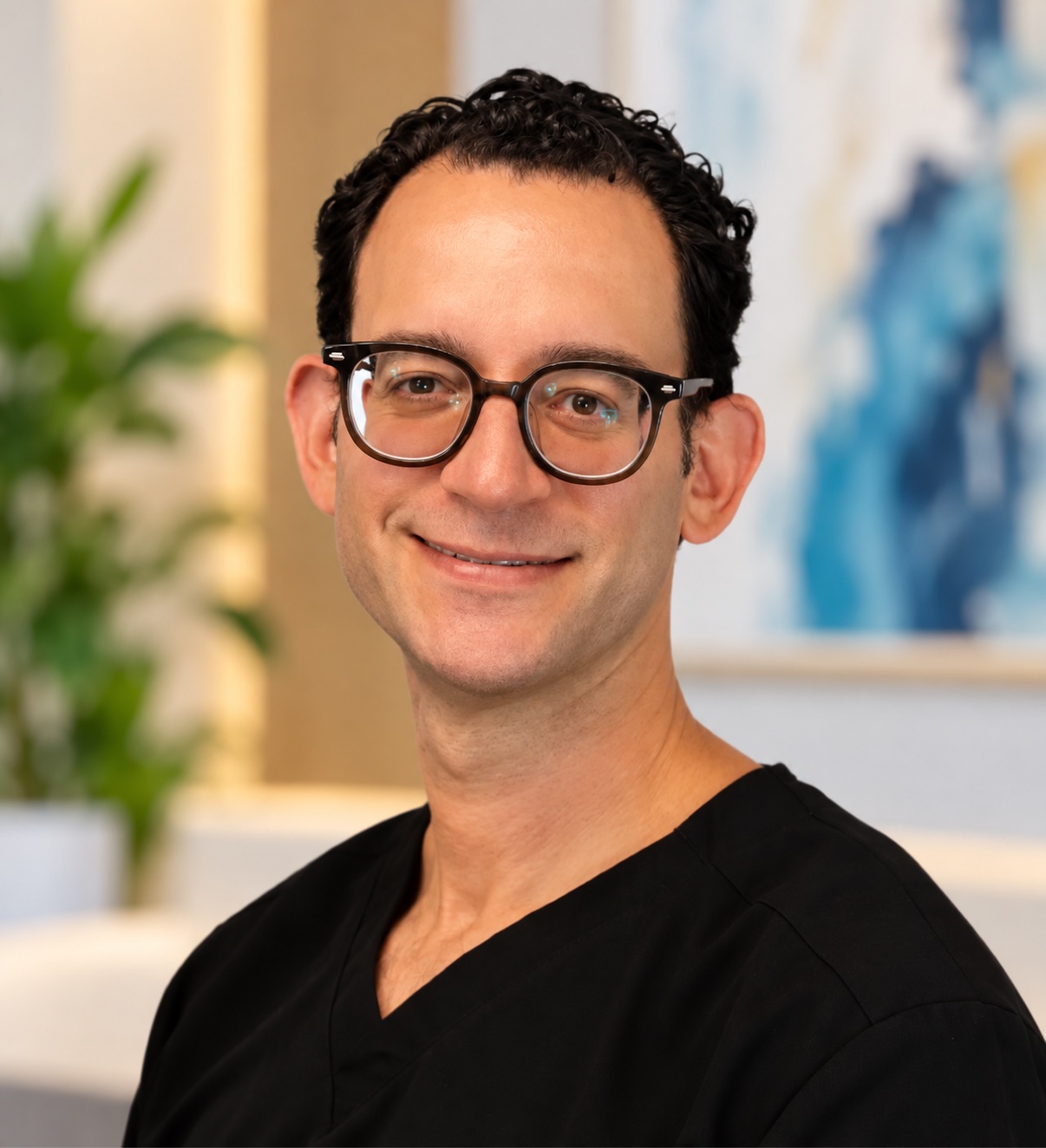
At PhD Dental, the implants beneath an overdenture are placed by our periodontist, Dr. Ori Levy — a board-certified periodontist (Diplomate of the American Board of Periodontology), trained at the UCLA School of Dentistry and in periodontics at the Greater Los Angeles VA Healthcare System, with nearly two decades of experience and about 15 years at PhD Dental. He sees patients at our Westchester office on scheduled days. Implant placement is the crucial step in an overdenture, and here it is planned by a specialist around the finished denture: the implant positions are chosen to hold the denture you will actually wear. The denture itself is fabricated by a high-quality dental laboratory, the implants use high-quality components, and our general dentists restore and fit your denture — so the whole journey, from implant placement to the finished denture, happens within one practice.
I want teeth that don’t come out at all — what are fixed, screwed-in dentures?
Some patients are done with removable teeth in any form, and for them there is a different category altogether. A fixed full-arch implant denture replaces every tooth in the upper jaw, the lower jaw, or both with a complete set of teeth secured to dental implants with screws. Patients call them ‘permanent teeth’ or ‘teeth that don’t come out,’ and the treatment is often called All-on-4 or All-on-X, after the small number of implants that hold the whole arch. The teeth stay in your mouth day and night — only your dentist removes them, for maintenance at your checkups.
The contrast with a snap-on denture is simple to hold onto: a snap-on overdenture clips onto its implants and you take it out each night to clean it; a fixed full-arch denture is screwed onto its implants and does not come out at all. Both are far steadier than a denture resting on gums alone — the decision is whether your new teeth come out for cleaning or stay fixed in place.
At PhD Dental, fixed full-arch implant dentures are made at our Westchester office. As with an overdenture, the implants are placed by our periodontist, Dr. Ori Levy, who sees patients at our Westchester office on scheduled days, and placement is planned around the finished set of teeth. Our general dentists then restore the treatment — they build and fit the fixed teeth on the implants — and the teeth are fabricated by the same high-quality dental laboratory, using high-quality implant components. The implants are given time to fuse with the bone before the finished teeth are fitted, so the complete process is measured in months rather than days; your consultation will lay out the timeline and the cost for your case before you commit to anything. Our All-on-X Dental Implants in Westchester page goes deeper on this treatment.
Why does my denture move, hurt, or collect food underneath?
Start from this fact: a denture sits on tissue that keeps changing shape. After teeth are removed, the gum and the bone under it remodel — quickly in the first year, then slowly for as long as you wear the denture — so a fit that was exact in January can rock by the following year. Worn denture teeth flatten the bite; a hairline crack or a single sore spot can tilt how the whole plate seats. Pain in the first days with a brand-new denture usually means one pressure point, and an adjustment visit finds and relieves it. A denture that has started dropping, rocking at meals, or packing food underneath is telling you its fit has changed; adhesive hides the message without answering it. What the exam leads to depends on how far the fit has drifted: a small adjustment, a reline that refits the denture’s inner surface to your gums as they are today, or a new denture when the old one is worn past saving — and when a lower denture will not stay seated at all, the implant option in the section above is the durable fix. One more thing patients are glad to hear: we repair and reline dentures made by other offices as well as our own. Every repair starts with an evaluation; what can be done and what it costs goes into a written estimate first.
A cracked denture, or a sore spot that makes wearing it miserable, is reason enough to call the Westchester office the same day: urgent care is part of what we do, and the denture is evaluated before any repair is promised.
Getting used to dentures
New dentures take practice — that is normal, and for most people it is a matter of weeks of adjustment, not days. Eating goes easiest at first with soft foods cut into small pieces and chewing on both sides at once; speaking clears up with reading aloud; a partial denture usually feels familiar sooner than a full one because your remaining teeth still do much of the work. Dentures come out at night: your gums need the rest, and nighttime is when the denture is cleaned and stored.
How much do dentures cost?
A single price for ‘dentures’ would not survive contact with a real mouth — the figure depends on which denture and on your case. Its ingredients:
- Full, partial, immediate, implant overdenture, or fixed full-arch. Each is a different amount of laboratory work; the implant options also include the implants and their placement.
- One jaw or both. Replacing the teeth in a single arch costs less than a full set.
- Whether teeth still need to be removed before the denture can be made.
- Whether bone preparation is needed to hold implants securely, for patients choosing an overdenture.
Begin with the $69 new-patient exam, which bundles the examination and a full set of x-rays together. After it, the office gives you a written breakdown of what your denture will cost before any work goes ahead; in-house payment plans and financing options are there if you would rather spread it out.
Does Medi-Cal pay for dentures?
Medi-Cal can cover conventional dentures when they are medically necessary — including immediate dentures when teeth need to be extracted. Dentures are renewable every five years under Medi-Cal. Medi-Cal does not pay for implant overdentures or for fixed full-arch implant dentures. Many Medi-Cal procedures require pre-authorization: we handle the authorization in-house and submit it electronically for you as soon as the diagnosis is made — the plan makes the final decision, and we let you know as soon as it comes back. Coverage depends on your case and your plan, so at our Westchester office we check your coverage before treatment — not after. We accept all PPO plans, including Aetna PPO, MetLife PPO, Delta Dental PPO, Cigna PPO, Guardian PPO, UnitedHealthcare PPO, Anthem Blue Cross PPO, Blue Shield of California PPO, Humana PPO, Principal PPO, Ameritas PPO, United Concordia PPO, Sun Life PPO, Lincoln Financial PPO, Unum PPO, The Hartford PPO, Renaissance Dental PPO, Premier Access PPO, and Health Net PPO. PhD Dental accepts all PPO plans at all eight offices. Please note we do not accept any HMO plans at this time.
We accept Medi-Cal. We accept Denti-Cal.
Common questions about dentures
Are implant dentures the same as snap-on dentures?
Yes — ‘implant dentures,’ ‘snap-on dentures,’ and ‘implant overdentures’ all describe a removable denture that clips onto implants. That is different from a fixed implant bridge or full-arch denture, which does not come out. At your consultation we will explain which arrangement fits your case.
Will my dentures look natural?
Your denture is made from records of your mouth, with the tooth shade and shape chosen with you, and fabricated by a high-quality dental laboratory. The aim is a set of teeth that suits your face — and most patients are surprised at how much like themselves they look in the mirror.
How long do dentures last?
Dentures wear with daily use, and the shape of your gums and jaw changes slowly over the years, so a denture’s fit changes with time even when the denture itself is sound. Regular checkups and professional cleanings — cleanings start from $125, including fluoride — let us check the fit and the health of your mouth, and adjust or reline the denture when it needs it. Under Medi-Cal, dentures are renewable every five years, which is a fair guide to the working life of a denture even outside that program.
What if I am nervous about extractions or implant placement?
Say the word when you book, and we will build comfort into the plan. Nitrous oxide is offered at select offices, upon request. A calming medication can also be prescribed for the night before and the morning of your appointment — with the firm condition that someone else drives you to the office and home again.
How do I start?
The first step is the $69 exam at Westchester. From it you get a clear plan — full, partial, immediate, implant overdenture, or fixed implant denture — and a written cost breakdown before you commit to treatment. Walk-ins are welcome at our Westchester office.
Dentures in Westchester and the communities around us
Our Westchester office is on La Tijera Boulevard, and patients come to us for dentures from all over this part of Greater Los Angeles. Our closest neighbors — Ladera Heights, View Park-Windsor Hills, Hyde Park, and Lennox — are just minutes away, and we also see patients from Playa Vista, Leimert Park, Culver City, Mar Vista, Palms, Del Aire, and Hawthorne. From the beach cities and the west side, patients travel in from Playa del Rey, El Segundo, Marina del Rey, Mid-City, Westmont, Vermont Square, West Athens, Lawndale, Venice, Alondra Park, and Manhattan Beach. Wherever you are coming from, your denture journey starts the same way here: an exam, a clear plan, and a written cost breakdown before any work begins.
Book a denture consultation in Westchester
Call our Westchester office at (310) 645-0336 to book a denture consultation, or book online anytime. Walk-ins are welcome.
- PhD Dental Westchester: 6907 La Tijera Blvd, Suite A, Los Angeles, CA 90045
- Call: (310) 645-0336
- Book online: Book an appointment
- Hours: Monday–Friday 9:30 AM–6:30 PM, Saturday/Sunday closed. This office is not open on Saturdays; on Saturdays, our Inglewood office is open 9:00 AM to 4:00 PM.